Through a Cracked Lens: Rohrabacher on Climate Science

Congressman Dana Rohrabacher of California has long been known as a crank climate denialist, but you may wonder – is it just an act to please a constituency, or are climate deniers really THAT stupid?

Listen to the speech, (mercifully short clip) hear the audience reaction, draw your own conclusions.

Below, if you haven’t seen it, Rohrabacher confronts Dr. Richard Alley in a congressional hearing.

Continue reading “Through a Cracked Lens: Rohrabacher on Climate Science”

Could Suburbia Be Sustainable?

I suspect this may generate some comment.
Gentlemen and women, start your engines.

Paul Brown for Climate News Network:

Urban sprawl may not be as bad for the environment as we thought – as long as every home is fitted with solar panels and electric cars become the norm.

LONDON, 8 August – Modern planners are building compact cities, believing tightly controlled zones are better for the environment. New research suggests the opposite: urban sprawl might be a better option, with solar power fitted to suburban houses and the adoption of electric cars transforming the energy needs of a city.

Research in Auckland, New Zealand – the largest urban area in the country and a city built for the age of the motor car – shows that solar panels fitted to the average suburban home can produce enough power for that household, extra to charge an electric vehicle, and still generate enough watts to export a surplus to the grid.

Adopting a citywide approach to fitting solar panels and providing charging points for cars would enable suburban homes to provide most of the power for the city centre as well as keeping the transport running, according to Professor Hugh Byrd, from the School of Architecture at the University of Lincoln in England.

In collaboration with the New Zealand Energy Centre and the University of Auckland, Byrd and his colleagues found that detached suburban houses typical of a motor car age city are capable of producing ten times more solar power than is possible from skyscrapers or other commercial buildings. The calculations are based on a detailed cross section of Auckland, which has skyscrapers in its business centre but has most of its homes spread out over the surrounding countryside in an urban sprawl.

Continue reading “Could Suburbia Be Sustainable?”

Food Plus Electricity: Solar Cells and Crops can Share the Sun

wspv
UC Santa Cruz

Santa Cruz.Com:

Truly renewable resources and self-sustaining systems are few and far between.  But what if you could have one in your garden? Imagine strolling through your back yard, past the calming sound of your cherub fountain, breathing in the smell of fresh earth. You enter your greenhouse, and a fan gently blows air into your face. Your spinach and lettuce are looking good, and even the artichokes are coming along. Languid ladybugs and fragrant flowers live in happy harmony.

In this near-future scene, you’ll be happy with your power bill, too. The fountain, the fan and the pumps watering your garden will all be powered by the greenhouse itself.

A team of scientific innovators from UCSC has created a self-sustaining system like this, using a new generation of solar panels. These devices trap just part of the sun’s light to produce electricity. The rest passes through, nourishing the growing plants underneath.

Solar energy has a promising future, but it fights for land with threatened species, agriculture and California’s natural landscape. The UCSC team—boosted by support from NASA—aims for a more cooperative way to extract power from the sun.

“Much of the current solar development in California scrapes away plants and flattens the habitat, then solar farms are installed,” says environmental studies professor Michael Loik, a photosynthesis expert at UCSC. “I want to install our technology in a way that is compatible with the native vegetation.”

Continue reading “Food Plus Electricity: Solar Cells and Crops can Share the Sun”

Lower Great Lakes Levels – Another New Normal?

Milwaukee Journal-Sentinel:

Lake Michigan is no longer just a Great Lake; it is a great unknown.

More ominous than the all-time low the lake touched this winter is the fact that it came after languishing for 14 years below its long-term average — another record. And when it did initially drop below that long-term average, it plunged three feet between 1998 and 1999 — yet another record for water lost from one year to the next.

The lake level, of course, has been in constant flux since record-keeping began a century and a half ago. Tracking it on a graph is like looking at an EKG monitor. Little blips and dips reflect seasonal oscillations that cause the lake, in a typical year, to vary about a foot between summertime high and wintertime low.

In addition to those annual ebbs and flows are larger swings that span decades tied to long-term weather patterns, with Lake Michigan’s record high topping out more than 6 feet above the record low set this January.

Draw a red line through the middle of all those highs and lows and you get what was, up until 1999, Lake Michigan’s long-term average surface level — 579 feet above sea level.

That year the lake mysteriously took its 3-foot dive, and it has stayed down for nearly a decade and a half — and counting.

Continue reading “Lower Great Lakes Levels – Another New Normal?”

Grist: How Crazy the House GOP has Become

wwz

Dave Roberts in Grist:

When I first started writing at Grist, in 2004 and 2005, the Bush administration was in charge and Republicans had majorities in both houses of Congress. Every day — and I mean, really, almost every single day — brought some new outrage, some bit of mendacity or corruption or plutocratic greed or just terrible policy.

I realized quickly that there’s no way for a healthy human being to maintain the level of outrage warranted by the situation. When offenses to decency follow one after another after another after another, it’s difficult to pay attention to each one, much less work up righteous umbrage anew each morning. It’s mentally and physically exhausting.

I was convinced at the time, and remain convinced, that this was a deliberate strategy on the part of conservatives: flood the zone and overwhelm the ability of the press, public, and political opposition to react. When you have power, use it to help your friends and secure future power; do not hesitate; do not ask permission.

Obama, whatever you think of his strategies or policies, has led a remarkably scandal-free presidency. That’s why, when something like the IRS (non-)scandal comes along, everyone jumps on it and it stays in the news for weeks. It’s a singular event, a marker, a symbol around which we arrange our perceptions and arguments. Under Bush, the IRS thing would simply have blurred into a parade of far worse transgressions. It’s no accident that “cocaine-fueled sex romp” is a mere fourth on our list of Bush Era WTFs. You just couldn’t keep up. It was numbing and profoundly disempowering — which, again, was the point.

I’ve been thinking about this ever since Republicans won the House of Representatives and an historic number of state legislatures in 2010, which they promptly used to gerrymander themselves a decade-long death grip on the House. The minute they took charge, they started doing insane things. Lots of these things became news — threats totank the American economy, forty-eleven votes to repeal Obamacare,stripping food stamps out of the farm subsidy bill — but many, perhaps most, did not, because crazy bills that passed the House were doomed in the Senate. “House passes crazy bill in futile gesture” is a story political journalists tire of writing.

I’m guilty too. I can’t write about it every time the House passes some bill that would slash EPA funding by half or open up the Grand Canyon to fracking or outlaw climate science or, y’know, repeal Obamacare again. Those bills die in the Senate. And I have my mental health to worry about.

But I also worry that your average American does not understand how extreme the House GOP has become, not only substantively but in terms of respect for democratic procedure. And I worry that the media’s inability to cover the insanity consistently, or call it what it is, is contributing to their ignorance.

Let’s look at one example.

Last Friday, the House passed the Regulations from the Executive in Need of Scrutiny (REINS) Act on a largely party-line vote of 232-183. I wrote about REINS as part of this piece, so I’m just going to quote myself:

[REINS] would require that every “economically significant” federal regulation (one that has an annual impact of $100 million or more) be affirmatively approved by Congress. Again: no rule would go into effect until it has been voted through by both houses of Congress and signed by the president. If a regulation is not voted on within seventy legislative working days of being sent to Congress, it is “tabled.” That is, it dies.

It’s difficult to overstate how radical a change this would represent for U.S. government. It would subject fifty to a hundred regulations a year to the partisanship, rancor, and gridlock of Congress. Every rule would be a new opportunity for lobbying and industry influence. Worse, legal observers say the bill does not clearly prohibit a filibuster in the Senate, raising the possibility that a determined minority of forty senators could effectively shut down federal rule making. REINS would not overturn the Clean Air Act or shutter the EPA, but it would end forward momentum in environmental law, freezing it in place.

Continue reading “Grist: How Crazy the House GOP has Become”

Antarctic Coastal Permafrost Melting Faster Than Expected

I’ve set up a script where I just hit the F2 key and a wordpress page comes up starting with the phrase, “For the first Time..”.

F3 brings up “Melting Faster than expected…”

Climatestate:

 For the first time, scientists have documented an acceleration in the melt rate of permafrost, or ground ice, in a section of Antarctica where the ice had been considered stable. The melt rates are comparable with the Arctic, where accelerated melting of permafrost has become a regularly recurring phenomenon, and the change could offer a preview of melting permafrost in other parts of a warming Antarctic continent.

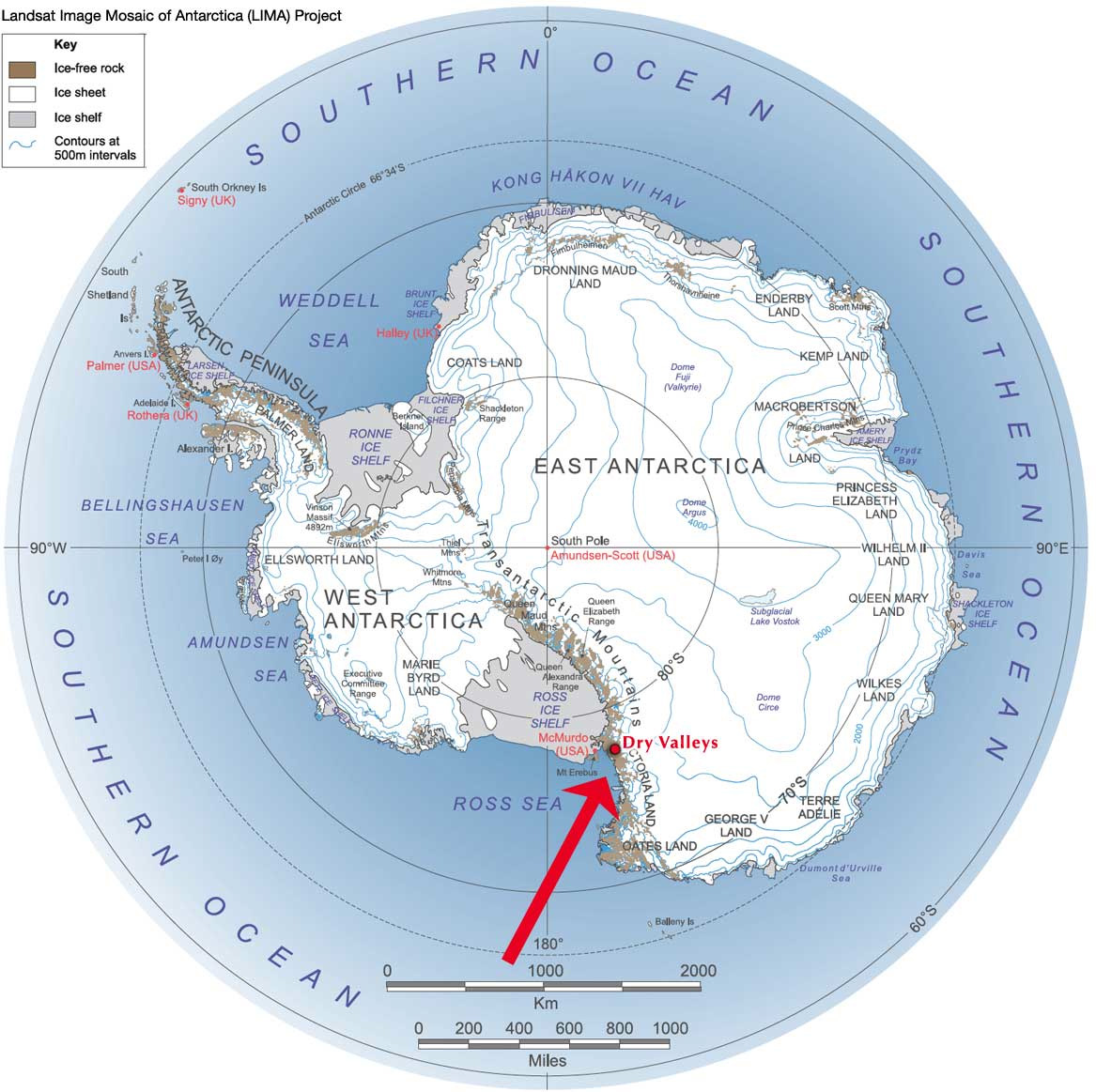
Tracking data from Garwood Valley in the McMurdo Dry Valleys region of Antarctica, Joseph Levy, a research associate at The University of Texas at Austin’s Institute for Geophysics, shows that melt rates accelerated consistently from 2001 to 2012, rising to about 10 times the valley’s historical average for the present geologic epoch, as documented in the July 24 edition of Scientific Reports.

ant_perma

Scientists had previously considered the region’s ground ice to be in equilibrium, meaning its seasonal melting and refreezing did not, over time, diminish the valley’s overall mass of ground ice.

Instead, Levy documented through LIDAR and time-lapse photography a rapid retreat of ground ice in Garwood Valley, similar to the lower rates of permafrost melt observed in the coastal Arctic and Tibet.

“The big tell here is that the ice is vanishing — it’s melting faster each time we measure,” said Levy, who noted that there are no signs in the geologic record that the valley’s ground ice has retreated similarly in the past. “This is a dramatic shift from recent history.”

Rising temperatures do not account for the increased melting in Garwood Valley. The Dry Valleys overall experienced a well-documented cooling trend from 1986 to 2000, followed by stabilized temperatures to the present.

Rather, Levy and his co-authors attribute the melting to an increase in radiation from sunlight stemming from changes in weather patterns that have resulted in an increase in the amount of sunlight reaching the ground.
Continue reading “Antarctic Coastal Permafrost Melting Faster Than Expected”

Oops. Methane Leakage from Fracked Wells “Alarmingly high..”

Full disclosure. Like a lot of other houses, mine is heated in the winter with natural gas – methane.  I’ve taken a lot of steps to make the house much more energy efficient than it was when I moved in- including better insulation, new windows, efficient furnace – and I know it uses a lot less energy than it used to. Still, I’m looking for other alternatives.

For the moment, we are stuck with natural gas as a widely used fuel. That’s something that probably needs to change sooner than we thought – certainly sooner than the rosy “100 years of natural gas” scenarios contemplate.

The leakage of natural gas from well heads, pipelines, and fracked fields is a major challenge, and seemingly turns the “natural gas is a bridge fuel” argument, one that I’ve subscribed to in the past,  on its head.

MySanAntonio:

Almost a tenth of the methane produced from oil and gas operations in a Utah site escapes into the atmosphere, according to a federally backed study published Monday.

An analysis of the report from the Environmental Defense Fund called the emission rate “alarmingly high.”

The study, which included researchers from the National Oceanic and Atmospheric Administration among others, was published Monday in the journal Geophysical Research Letters.

It found that 9 percent of methane produced from drilling sites in a portion of Utah’s Uintah Basin escaped, said Colm Sweeney, one of the study’s main authors and a scientist at the National Oceanic and Atmospheric Administration’s Earth Systems Research Laboratory in Boulder, Colo.

Brian Straessle, a spokesman for the American Petroleum Institute, said the industry trade association hasn’t reviewed the new report, but cited other studies that found the portion of methane that escapes from wells is less than 2 percent.

Sweeney said the higher level found in the Uintah Basin study could cancel out environmental advantages of burning natural gas produced there.

He noted that natural gas is efficient because compared with other fossil fuels its combustion releases less of the greenhouse gas carbon dioxide, which is linked to climate change.

“But in order to properly account for this global warming benefit, you have to account for the leakage from the well hole to the point of use — and so that’s the critical problem that we’re trying to understand better,” Sweeney said.

High emissions of methane are troubling, Sweeney said.

“Methane immediately out of the ground will have a warming potential that is 100 times greater than carbon dioxide,” he said. “So you need a lot less methane to get a much higher global warming effect.”

Continue reading “Oops. Methane Leakage from Fracked Wells “Alarmingly high..””

Rolling Stone’s “Dark Snow” Issue Doubles Sales

bomber_red

Sales of Rolling Stone’s issue containing coverage of the Dark Snow Project Greenland mission were double the average.  Most of the media explanations cite the predictable reaction to attempts to ban the magazine from newsstands – owing to the placement of Boston Marathon bomber Dzhokhar Tsarnaev on the cover.

The Independent:

Rolling Stone magazine saw sales of its controversial ‘Boston Bomber’ edition double despite calls from retailers and readers to boycott the publication.

Figures released by the Magazine Information Network show sales jumped by 102 per cent over average per issue sales in the past year.

Following publication of last month’s edition, a ‘Boycott Rolling Stone’ Facebook page was created, encouraging readers to abandon the magazine.

The cover featured a picture the 19-year-old bombing suspect Dzhokhar Tsarnaev had taken of himself, which had already appeared on the cover of The New York Times. The image was accompanied by the headline “The Bomber”, followed by: “How a popular, promising student was failed by his family, fell into radical Islam and became a monster”.

Huffington Post:

It looks like all that drama over Rolling Stone’s recent issue featuring alleged Boston bomber Dzhokhar Tsarnaev on its cover really paid off for the magazine.

The cover, which critics said “glamorized” Tsarnaev, was banned from pharmacies and supermarkets, denounced by Boston’s mayor, defended and trashed in the media, and even targeted in a proposed public burning campaign.

But, according to AdWeek, the issue sold more than double Rolling Stone’s usual average newsstand sales. Apparently, people wanted to see what all the fuss was about.

It could be this analysis is correct – but, still, there was the rock star treatment of Jason Box.  We won’t know if we’ve succeeded in making climate science cool till fall  – if Jason’s picture shows up pasted inside young girl’s school lockers- but I think its at least possible that word of mouth about the “Ice Maverick” might have been a small part of the buzz.  To be fair, it could have been the piece about Willie Nelson, too…

If you still haven’t read Jeff Goodell’s piece, you can catch it online here…

maverick