Anti-Renewable Efforts Called Out and Turned Back

renewable

The Koch brothers and other fossil fuel interests are fighting an increasingly desperate war against deployment of renewable energy. They know that the steadily increasing competiveness of wind, solar and other alternatives are fast overtaking their 19th century model for energy production.

In some cases, they can slow things down, but over the long term, they are guaranteed to lose. Their play is to delay and keep milking fossil fuel profits for as long as possible.

Bangor Daily News:

Put into effect nearly 15 years ago with bipartisan support, Maine’s Renewable Portfolio Standard has created thousands of jobs, cut down on harmful pollution and helped to keep more of Mainers’ energy dollars in the state. Requiring 30 percent of the state’s energy providers’ electricity sales to come from renewables such as wind, solar, biomass, geothermal and hydroelectric power, it has also led to tremendous investment by renewable energy companies that are paying more than $17 million annually in property taxes and employing more than 2,500 Mainers.

Simply put, the Renewable Portfolio Standard is working — for everyday Mainers and businesses alike. In light of our struggling economy, programs such as the RPS should be celebrated and protected. So what could possibly have motivated Gov. Paul LePage to devote an entire weekly radio address to attacking the program? And why are some elected officials pushing legislation that would dismantle it?

A new report by the Maine Conservation Alliance, Maine’s Majority Education Fund and Maine People’s Alliance, issued earlier this month, sheds some light on the powerful forces fueling LePage and his allies’ efforts to weaken Maine’s RPS: Charles and David Koch, billionaire industrialists from Kansas and owners of the second largest private company in the U.S. with revenues estimated at $100 billion a year.

Continue reading “Anti-Renewable Efforts Called Out and Turned Back”

Camera Test Among Wind Turbines

sunturbine1small

I don’t chase tornadoes, although I get the appeal. Adrenalin is the most powerful and seductive drug – speaking as a former street paramedic, I know.

What I do, though, is chase moments. Or, not so much chase, as wait for them to arrive – as they do every day without fail. All moments are good, but some moments are better than others.

I’m road testing the kit I’ll be taking to Greenland, which will include the Canon T4i, and happened to be in the right place, right time, the other day, in the middle of Michigan’s largest wind array, not far from my home. Click the pictures for larger versions.

sunturbine2small

Continue reading “Camera Test Among Wind Turbines”

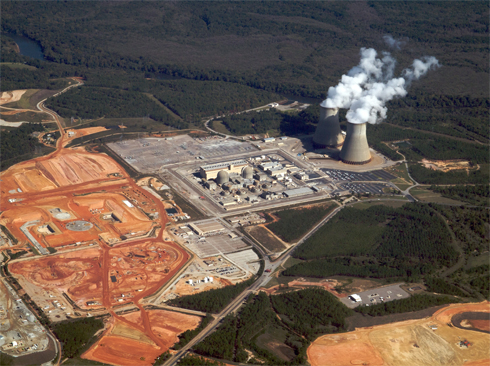
Tea Party Turns on Georgia Nuke, Pushes Solar

vogtle2

Man bites Dog.

I guess somebody in the Tea Party reads this blog.

AP via Salon:

ATLANTA (AP) — Tea party activists in Georgia are taking what appears to be a rare stand on energy, challenging a power utility’s reluctance to increase solar energy and questioning the ballooning costs of building a nuclear power plant.

The Atlanta Tea Party’s action is relatively unusual among loosely linked tea party organizations nationally.

Other tea party groups have condemned the adoption of “smart” utility meters that transmit information about customer usage, due to concerns that they would intrude on customers’ privacy. Or they have broadly backed less reliance on foreign energy.

But relatively few have endorsed so specific an energy platform in their own backyards, much less promised to campaign on it.

Miami Herald:

“It certainly isn’t anything personal, but one of our core values is promoting the free-market system,” said Julianne Thompson, a co-founder of the Atlanta Tea Party.

The electricity market in Georgia is not a free market. State law gives electric utilities, including Georgia Power, exclusive rights to serve customers in designated areas of the state. Most customers cannot choose their provider.

While monopolies have more power to charge higher prices than firms in competitive markets, there are times when it makes sense to allow them if their prices are regulated.

It would be more expensive to build more than one system of electric wires or natural gas pipelines to deliver power and fuel to every home in a state. Customers are better off if just one system is built and maintained, as long as the company that runs the system is prohibited by regulators from using its monopoly power to drive up prices.

In many states, including Texas and most of the Northeast, power delivery is regulated, but customers can choose who provides their electricity. Customers in those states can choose from companies that provide such options as renewable power or a slate of pricing options, including fixed rates, rates that vary with market fluctuations, or rates that vary based on when during the day power is used.

Georgia Power makes a natural political foil for the tea party. A 2011 poll conducted by Yale University and George Mason University found that tea party members were far more likely than Democrats, Republicans or independents to distrust central authority and strongly opposed energy policies that raise costs, even if there are other benefits.

Yale University researcher Anthony Leiserowitz, who worked on the poll, said he was not surprised local tea party supporters might challenge a monopoly.

“That totally taps into that same sense that there are these big, institutional forces against which you’re a little guy and you need to rebel,” he said.

Continue reading “Tea Party Turns on Georgia Nuke, Pushes Solar”

Tornado Chasers: A Tragedy Waiting to Happen

Paul Douglas:

“…If anything, the events of Friday evening demonstrate storm chasers need to back off. For too long, too many chasers – both professional and amateur – have been crossing the line…” – excerpt of a post from Washington Post meteorologist Jason Samenow. Story below. Tweet above from a chronology from Digital Meteorologist, which has more on Friday evening’s tornado tragedy.

The Wrong Message

At least 9 people were killed in Friday evening’s Oklahoma City EF-3 tornado, including 3 professional tornado researchers. Unlike amateur chasers out searching for a cheap thrill Tim Samaras was pushing the envelope as a scientist. Previous projects included planting “turtles” in the path of tornadoes to get video, wind and pressure information.

On Friday one of the local OKC TV weathermen encouraged viewers to get into their cars and try to drive away. The result? Gridlock. Massive traffic jams. Tim, his son and a third tornado intercept professional were caught in a deadly logjam of cars, unable to escape to safety as the tornado took a sudden 45-degree turn.

Word to the wise: if you’re already home and a Tornado Warning is issued stay home! Otherwise you’re just a sitting duck.

A tragic story.

traffictornado
Image upper left from RadarScope app shows location of storm chasers in relation to El Reno tornado. Image upper right shows traffic jam on I-35 south of Oklahoma City, courtesy of KWTV.

New Video: Climate, Ice and Weather Whiplash

New video for my “This is Not Cool” series thru the Yale Forum on Climate Change and the Media.

Last year I spoke to Dr. Jeff Masters and Dr. Jennifer Francis about the emerging research linking “weather whiplash” events, back to back extremes of all  types that seem to have become our new normal, and the disappearance of arctic ice.

This year, the extremes continue. I’ve revisited Dr. Francis on the issue, to talk about what last year’s “July in March” spring has in common with this year’s cold and sluggish roll into  summer here in North America.

Dr. Francis has become a bit of a rockstar on the Meteorology wonk circuit in the last year, as she makes a compelling case that the loss of arctic sea ice, and more broadly, polar amplification of climate change, and its effect on the jet stream, has been an important driver of the changes we have seen.  It appears that this may be an emergent property of atmospheric circulation that has not been well modeled or foreseen.

But it’s not pound-on-the-table-we’re-done science yet. I also talked to Dr. Kevin Trenberth,  who is not quite ready to go along with Francis’ model.  I’ll be posting his remarks,  Francis’ responses, and a synthesis by Dr. Masters, in a future video.

For now, an update on current observations.

May 2013: “Weather Whiplash” and “Wummer”

I’ll be posting a new “This is Not Cool” video later today updating the observations, and possible mechanism, of the “Weather Whiplash” behavior that characterizes our New Normal, including part of a new interview with Dr. Jennifer Francis.

Above, Paul Douglas of WeatherNationTV points out some of the astounding extremes in temperature during May. In 2013, we’ve gone directly from winter, to summer, with nothing in between.

Winter ->Summer = Wummer?

Below, Paul discusses freak snow and precipitation nationwide, and the snap from drought to flood across the midwest.

Weekend Wonk Bonus: Sobering Sediments from Lake E

Big implications here for DarkSnowproject research.

Skeptical Science:

Here is a must-see 2012 presentation by Julie Brigham-Grette of the University of Massachusetts Amherst, covering the research her team has been doing into Lake El’gygytgyn (pronouned El-Guh-Git-Kin), a water-filled meteor crater in Arctic Russia that came into being after the impact of a ~1km diameter space-rock, 3.6 million years ago.

This is incredibly important work because:

  • The Lake El’gygytgyn region was not glaciated during any of the ice ages. As a consequence, the >300m accumulated sequence of lake sediments represents a continuous, undisturbed sedimentary record going all the way back from the present to the aftermath of the impact.
  • The team succeeded in 2009 in extracting cores spanning this entire 3.6 million year period.
  • The oldest continuous ice core records to date extend 123,000 years in Greenland and 800,000 years in Antarctica: the Lake El’gygytgyn cores go way back beyond those times and provide an unprecedented view of the past climate of the Arctic.
  • Results show that during the Pleistocene (2.588 million – 11.7 thousand years ago), there were a number of super-interglacials – like the present period but much wetter and several degrees warmer in the Arctic, during which the Greenland and West Antarctic ice-sheets didn’t just melt a bit. They disappeared.

Skeptical Science recently covered the new 2013 paper by the same team, describing the Arctic climate in the Lake El’gygytgyn region during the Pliocene, when boreal forests extended well up into the Arctic and summer temperatures were 8oC warmer than they are at present:

The last time carbon dioxide concentrations were around 400ppm: a snapshot from Arctic Siberia

The data coming from Lake El’gygytgyn strongly suggest that the Arctic climate is highly sensitive to small changes in forcing, warming much faster than the rest of the world in the phenomenon known as Arctic Amplification. In recent years, Arctic Amplification has emerged as a strong modern-day climate signal. To cite but one example, the sea-ice response has been of far greater magnitude than model-based forecasts projected. Now, the past is giving a similar narrative, and understanding the climate of the past gives us our best chance of understanding the climate of the future.

The recent publication of the research discussed above was covered at ClimateProgress, and here is the press release from UMass.

Money quotes at 17:00

“..Greenland Ice sheet has come and gone much more frequently than
any of us had imagined.”

19:48
“..exteme warmth many times throughout the last few million  years”

“..It may be much easier to get rid of sea ice than we thought before.”

supportdarksnow

The Weekend Wonk: Trenberth on Ocean Heat and Surface Temps

I’ll be doing a longer video piece on the whole issue of climate sensitivity that has been current over the last few months.  One of the first people I wanted to talk to was Dr. Kevin Trenberth – and you can see part of the longer skype interview above.  Trenberth contributed to a recent paper showing that the deeper ocean has been collecting more heat over recent years, a factor that has to be considered in any discussion of global surface temps in the past decade or two.

Below, you can read Dr. Trenberth’s very valuable discussion of the issue, recently posted on the  “Conversation” blog series out of Australia.

The Conversation:

Has global warming stalled? This question is increasingly being asked because the local weather seems cool and wet, or because the global mean temperature is not increasing at its earlier rate or the long-term rate expected from climate model projections.

The answer depends a lot on what one means by “global warming”. For some it is equated to the “global mean temperature”. That keeps going up but also has ups and downs from year to year. More on that shortly.

Why should it go up? Well, because the planet is warming as a result of human activities. With increasing carbon dioxide and other heat-trapping greenhouse gases in the atmosphere, there is an imbalance in energy flows in and out of the top of the atmosphere: the greenhouse gases increasingly trap more radiation and hence create warming. “Warming” really means heating, and this can exhibit itself in many ways.

trenberthleftRising surface temperatures are just one manifestation. Melting Arctic sea ice is another. So is melting of glaciers and other land ice that contribute to rising sea levels. Increasing the water cycle and invigorating storms is yet another. But most (more than 90%) of the energy imbalance goes into the ocean, and several analyses have now shown this. But even there, how much warms the upper layers of the ocean, as opposed to how much penetrates deeper into the ocean where it may not have much immediate influence, is a key issue.

The ups and downs of global temperature

My colleagues and I have just published a new analysis showing that in the past decade about 30% of the heat has been dumped at levels below 700m, where most previous analyses stop.

The first point is that this is fairly new; it is not there throughout the record. The cause of the shift is a particular change in winds, especially in the Pacific Ocean where the subtropical trade winds have become noticeably stronger, changing ocean currents and providing a mechanism for heat to be carried down into the ocean. This is associated with weather patterns in the Pacific, which are in turn related to the La Niña phase of the El Niño phenomenon.

Ocean Heat Content from 0 to 300 meters (grey), 700 m (blue), and total depth (violet) from ORAS4, as represented by its 5 ensemble members. The time series show monthly anomalies smoothed with a 12-month running mean, with respect to the 1958–1965 base period. Hatching extends over the range of the ensemble members and hence the spread gives a measure of the uncertainty as represented by ORAS4 (which does not cover all sources of uncertainty). The vertical colored bars indicate a two year interval following the volcanic eruptions with a 6 month lead (owing to the 12-month running mean), and the 1997–98 El Niño event again with 6 months on either side. On lower right, the linear slope for a set of global heating rates (W/m2) is given. Skepticalscience.com

Continue reading “The Weekend Wonk: Trenberth on Ocean Heat and Surface Temps”