At Michigan’s Largest Wind Farm, Those Crickets are Driving me Crazy

Michigan is in the national spotlight this season with a ballot proposal to require 25 percent renewable energy by 2025.

Naturally, I produced a completely unsolicited spot in support.  My reward is the knowledge that somewhere, somehow, a fossil funded windbagger blowhard might be annoyed.

The “25 by 25” initiative, at this point, is leading in the polls, with 55 percent voter approval. There is a tidal wave of fossil fuel money about to be unleashed against it, and a plucky band of citizen’s groups, small business peoplelabor unions, the NAACP, and activists supporting it.

Wish us luck.

Dave Roberts in Grist:

Probably the most important energy-related vote this November is happening in the swing state of Michigan, where voters will decide whether to substantially boost the state’s renewable energy standard (RES). It’s a big deal for all sorts of reasons, many of which extend beyond the state itself. So let’s walk through the background.

In 2008, Michigan passed a law to require the state’s utilities to generate 10 percent of their power from renewable energy sources by 2015. It was an extremely cautious RES, full of defensive provisos prohibiting anything that would cost more than coal power or raise electricity rates.

This year, the Michigan Public Service Commission, which oversees compliance, issued an updated report [PDF] on how implementation is going. The top-line conclusion is that implementation is going smoothly and “providers are on pace to hit the 2012 interim targets as well as the 10 percent by 2015 renewable energy standard.” Whee!

Renewable energy in the state is exploding:

Continue reading “At Michigan’s Largest Wind Farm, Those Crickets are Driving me Crazy”

Climate Denier Rick Santorum: “We Will Never Have Smart People on Our Side”

If you ever were looking for evidence of just how far thru the looking glass we’ve come – see this clip from climate denier Rick Santorum. (see below)

“Smart People”, I guess, join Muslims, blacks, latinos, gays, women,union people, environmentalists, and scientists as being, sadly, ineligible for the republican party, at best, and at worst, members of a sinister global conspiracy – presumably aimed at “dumb people”.

Fossil Fuel Industry Doubles Down on Decades of Lies

Description:

Check out the coal industry’s deceptive advertisements at http://www.quitcoal.org/coalads. Since the 1970s, the coal industry has been deploying deceptive advertising campaigns to scrub its image and delay important clean air standards. They use the same arguments year after year — environmental protections will cripple the economy, the science behind pollution problems is inadequate, and that coal is already clean.

NYTimes:

WASHINGTON — When Barack Obama first ran for president, being green was so popular that oil companies like Chevron were boasting about their commitment to renewable energy, and his Republican opponent, John McCain, supported action on global warming.

As Mr. Obama seeks re-election, that world is a distant memory. Some of the mightiest players in the oil, gas and coal industries are financing an aggressive effort to defeat him, or at least press him to adopt policies that are friendlier to fossil fuels. And the president’s former allies in promoting wind and solar power and caps on greenhouse gases? They are disenchanted and sitting on their wallets.

This year’s campaign on behalf of fossil fuels includes a surge in political contributions to Mitt Romney, attack ads questioning Mr. Obama’s clean-energy agenda, and television spots that are not overtly partisan but criticize administration actions like new air pollution rules and the delay of the Keystone XL oil pipeline from Canada.

With nearly two months before Election Day on Nov. 6, estimated spending on television ads promoting coal and more oil and gas drilling or criticizing clean energy has exceeded $153 million this year, according to an analysis by The New York Times of 138 ads on energy issues broadcast this year by the presidential campaigns, political parties, energy companies, trade associations and third-party spenders.

That tally is nearly four times the $41 million spent by clean-energy advocates, the Obama campaign and Democratic groups to defend the president’s energy record or raise concerns about global warming and air pollution. The Times rated presidential campaign and national policy ads by whether they promoted fossil fuels or pushed clean energy and conservation, regardless of their sponsors, using ad and spending data compiled by Kantar Media, a company that tracks television advertising.

In one state, an important ballot initiative this fall would mandate renewable energy goals for the state. In the face of an avalanche of fossil fuel money and disinformation, citizens groups fired an opening shot in the media war today.

Why Cheap Gas is Hot Air

Amory Lovins and Jon Creyts – Rocky Mountain Institute:

Would you build a buy-and-hold financial portfolio from only junk bonds and no Treasuries by considering only price, not also risk? Not for long. Yet those who say cheap natural gas is killing alternatives—solar, wind, nuclear—make the same error. In truth, they’re doing the math wrong: the gas isn’t really that cheap.

“Cheap gas” reflects only the bare spot price of the commodity without adding the value of its price volatility. Yet such competitors as efficiency and renewables have no fuel and hence no fuel-price volatility: once built, they’re as financially riskless as Treasuries. Of course, much gas is sold not at spot but on long-term contract, especially to its biggest user—electricity generators. But for other players, it’s vital not to become the patsy in the poker game: basic financial economics says asset comparisons must value and equalize risk.

One way is to compare fuel-free competing technologies with constant-price gas. A broker will take the price-volatility risk for a fee based on the market’s risk valuation, discoverable from the “straddle”—the sum of the prices of simultaneously sold put and call options. A year ago, when the cheap-gas mania was taking hold, gas-price volatility five years out was worth more than recent spot gas prices. Even today, with lower price and volatility (whose value automatically falls with price), gas’s price volatility alone, over a time horizon appropriate for comparison with durable assets, is worth roughly what gas now sells for. Omitting price volatility thus understates gas’s true cost (excluding its fixed delivery costs) by about twofold—a very material error.

A leading promoter of shale-gas fracking, asked about this at a recent financial conference, replied, “Trust me!” Gas, he claimed, would remain very cheap for a very long time. So how much gas would he contract to sell for a constant $2–3 per thousand cubic feet for 20–30 years, backed by solid assets unlinked to hydrocarbon prices? Probably none.

Actually, you can buy gas today for delivery at least a decade hence. Sure enough, it costs 2–3 times more, or about $6. So why doesn’t a fracking promoter lock in huge profits by shorting gas futures? Because shale gas (unless sweetened by valuable liquid byproducts) has lately sold at below its cash production cost. The reasons include frenetic drilling (driven by use-it-or-lose-it leases and the need to book big reserves to raise cash), pricey oil spurring plays in oily shales, and filled storage due to a mild winter. Those low 2012 natural gas prices will probably prove as transient as the even lower real prices of 1995–2000.

The gas industry’s inherent short-term price volatility is due to weather, storage, trade, and other factors. The April 2012 low gas price rose 31% by the end of May and doubled for delivery two years hence. Uncertainties increase further out because economies are complex and unpredictable. The fracking revolution didn’t repeal basic economics: to get $6–8 gas, just assume $3–4 gas, use it accordingly, and watch supply and demand reequilibrate at higher prices.

In fact, traders’ confounded attempts to forecast supply and demand dynamics for natural gas have helped accentuate this volatility. The track record of official price forecasts is abysmal (see Figure), and private forecasts weren’t much better. Three times in the past 15 years, huge investments—such as $100-odd billion worth of mistimed combined-cycle gas turbine generators bought in the late ’90s—were painfully stranded or misdirected when gas price forecasts shifted abruptly.

Continue reading “Why Cheap Gas is Hot Air”

On Heels of Hellish 2012, El Nino Warming Waiting in Wings

The graph tracks the effects of the El Nino and La Nina cycles on the NASA global temp record. El Nino exerts a warming effect on global temps, La Nina, a cooling effect. Mt Pinatubo was the last volcanic eruption large enough to exert a global effect.

Stefan Rahmstorf in Slate:

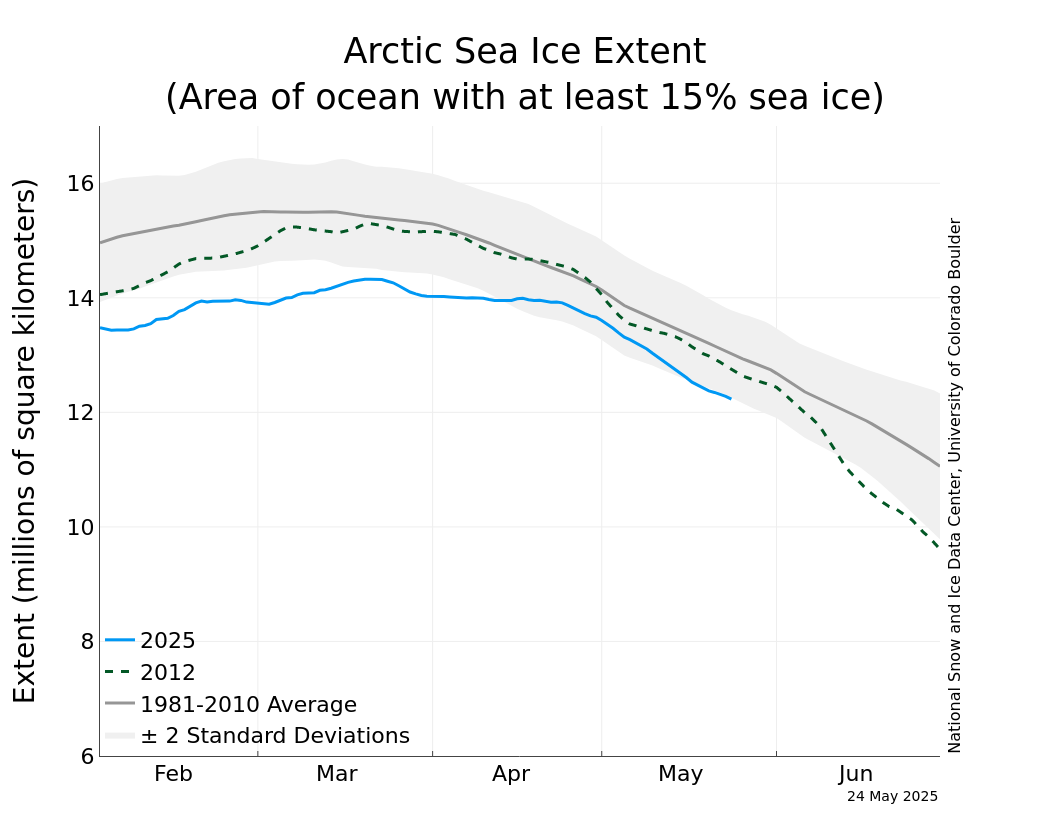
It has been another “normal” global-warming summer in the Northern Hemisphere. The United States sweltered in the hottest July on record, following the hottest spring on record. More than 60 percent of the contiguous United States is suffering from drought, as are parts of eastern Europe and India. In the Arctic, sea ice cover is at a record low, and the Greenland ice sheet shows what the U.S. National Snow and Ice Data Center calls “extraordinary high melting.” Global land temperatures for May and June were the hottest since records began in the 19th century.

Meanwhile, El Niño conditions are forecast to develop in the tropical Pacific Ocean, warming up ocean surface temperatures. Some observers have predicted that this will lead to record-breaking global temperatures next year.

If El Niño does arrive and temperature records are broken, there will inevitably be much discussion of the causes of the warming. So now is a good time to sort signal from noise in the global temperature records.

Continue reading “On Heels of Hellish 2012, El Nino Warming Waiting in Wings”

Rock the Debates: Bring Climate to the Presidential Debates

Climate Change is now part of the electoral conversation – and polls show the candidate who has takes the issue seriously and will deal with it can get more support from the important independent voters.

League of Conservation Voters petition here to urge Jim Lehrer, Presidential Debate moderator, to include questions about climate change in the upcoming presidential debates.

“A Big Problem – Much Bigger than we thought” – The New Science of Glaciers

Really high quality video following glacier scientists in New Zealand utilizing new techniques for fine tuning our understanding of glacier melt over long periods.

Worth watching and bookmarking for the photography alone, but extremely interesting science here. Only 8 minutes, from the Department of Education at the American Museum of Natural History

Description:

Analysis of Earth’s geologic record can reveal how the climate has changed over time. Scientists in New Zealand are examining samples from the rocky landscape once dominated by glaciers. They are employing a new technique called surface exposure dating, which uses chemical analysis to determine how long minerals within rocks have been exposed to the air since the glaciers around them melted. Comparisons of this data with other climate records have revealed a link between glacial retreat and rising levels of carbon dioxide in the air, findings that are informing scientists’ understanding of global climate change today.