


For those of us in the upper midwest, it’s been a disorienting winter. We’ve finally gotten a kept a small amount of snow in my area – but I suspect way too late to salvage the season for ski resorts, snow mobilers or ice fishermen.
A Meteorologist friend passes along this, a graph of the changes for Minneapolis/St. Paul minimum winter temperatures over the last several decades, that I am sure are typical of the region – indicating exactly the steady warming that all of us have observed.
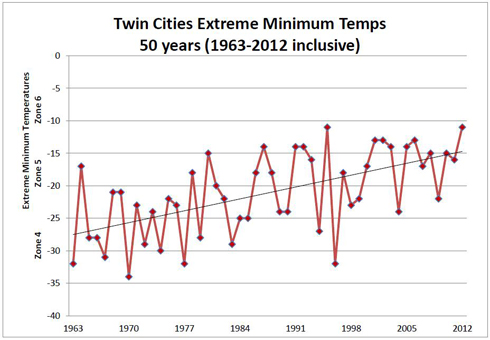
Let’s take a look at the historic EMT data for Minneapolis/St. Paul from the University of Minnesota Climatology Working Group site (http://climate.umn.edu/doc/prelim_lcd_msp.htm). For example, if we take the same 30 year period as the just released USDA study (1976-2005 inclusive), the average annual extreme minimum temperature (EMT) was -19.4 degrees, which is right on the low edge of Zone 5a. However, if we update these numbers for the 30 year period just ending (1983-2012) the average annual EMT becomes -18.6, which is more convincingly in Zone 5a. That average is definitely being “pulled” by the warmer winters of the last 10 years. For the 10 years 2003-2012, the average EMT is -16.1 degrees, which is closing in on Zone 5b (EMT -10 to -15). Although the winter of 2012 is still with us, it appears that our EMT was -11 degrees on January 19th, which is edging close to Zone 6a (EMT -5 to -10). Having lived in Zone 6a (Detroit) until 1977, I can attest that this winter reminds me a lot of southern Michigan.

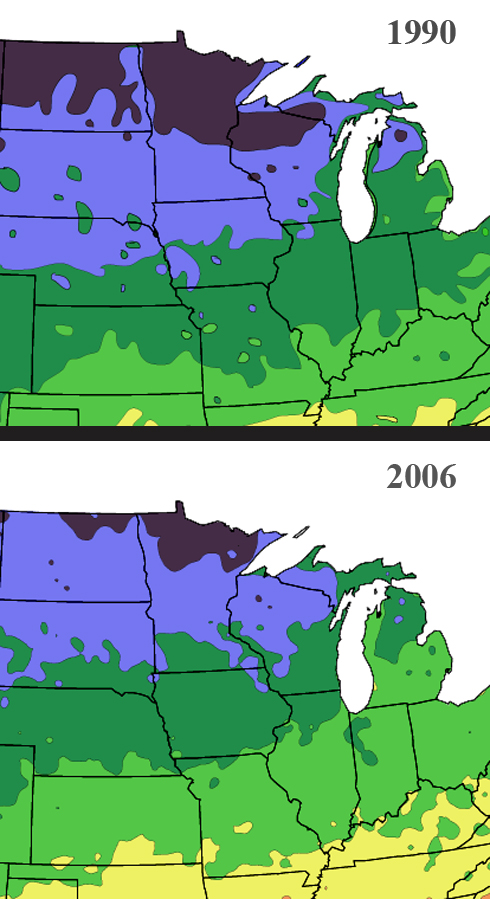
Astute readers will recognize that the US Department of Agriculture’s Hardiness Zones maps have changed over the years, reflecting weather changes obvious to farmers, gardeners, or anyone who spends time outdoors throughout the year. A quick look at the comparison between 1990 and more recent years shows why winter, not just this winter, but any winter, feels more like Kentucky than the upper midwest I grew up in.(these comparative maps, based on NCDC data, are from the Arbor Day Foundation, and demonstrate the changes)
The national map shows similar changes. Take note that these calculations are already 6 years old or more.
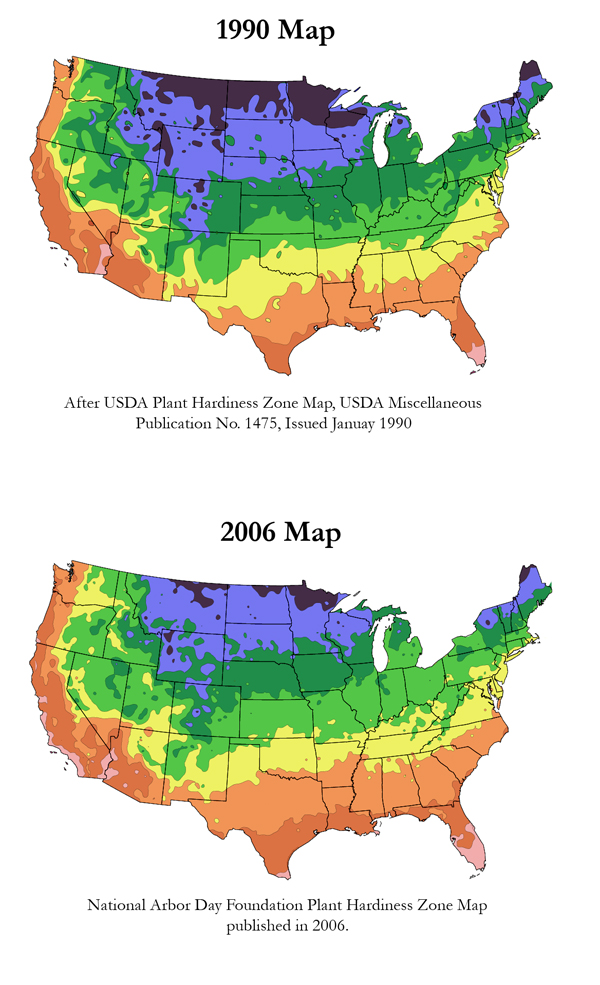
I would love to find the average temps for Salt Lake, which, according to the hardiness maps, has warmed also. Where might I find long-term data for Utah?
Many thanks!!
Brian
not sure.
google is your friend!
Ja sure, Peter. That there ice fishing photo is a hum-dinger!
You betcha!
Tom Smerling
Displaced Minnesotan
after I get back from fishin my wife has a casserole in da oven.
I hope you remembered it’s Valentines day.