

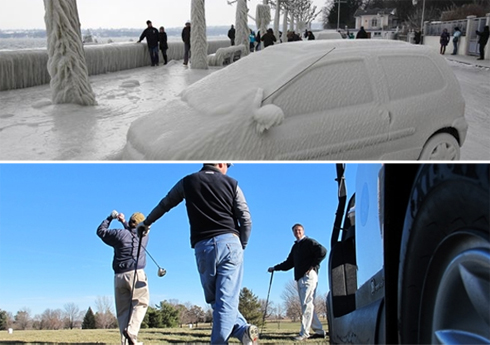
While the upper midwest of the US experiences days of sparkling clear and snowless weather, other parts of the globe are experiencing extremes of another kind.
The bitterly cold weather sweeping Britain and the rest of Europe has been linked by scientists with the ice-free seas of the Arctic, where global warming is exerting its greatest influence.
A dramatic loss of sea ice covering the Barents and Kara Seas above northern Russia could explain why a chill Arctic wind has engulfed much of Europe and killed 221 people over the past week
A growing number of experts believe complex wind patterns are being changed because melting Arctic sea ice has exposed huge swaths of normally frozen ocean to the atmosphere above.
In particular, the loss of Arctic sea ice could be influencing the development of high-pressure weather systems over northern Russia, which bring very cold winds from the Arctic and Siberia to Western Europe and the British Isles, the scientists believe. An intense anticyclone over north-west Russia is behind the bitterly cold easterly winds that have swept across Europe and some climate scientists say the lack of Arctic sea ice brought about by global warming is responsible.
Jeff Masters on All Things Considered:
CORNISH: Lots of folks have been talking about this crazy weather being, you know, climate change, essentially. And do you – is there any connection?
MASTERS: Well, at this point, we don’t know. I have to say I’ve been a meteorologist for 30 years, and when I look at the atmosphere over the last couple of years, it’s really not the atmosphere I know anymore. There have been substantial changes. We’ve seen major perturbations to the rhythms I’ve grown accustomed to. And when you start seeing unprecedented events, like we’ve seen in the past few years, you do have to look at, well, is there a major climate-altering force at work?
And, well, we know there are. There are a lot of heat-trapping gases, like carbon dioxide, going in the atmosphere, and those could potentially cause some of these unprecedented events, though we don’t have any theory right now that can show exactly what’s going on.
Meanwhile, a snow drought for the U.S.
In the U.S., it’s been the opposite story, with temperatures 10 – 15°F above average continuing this week over much of the nation. January 2012 is in the weather record books as the 3rd least-snowy January for the contiguous U.S. since snow records began in 1966, and December 2011 ranked as the 11th least snowy December on record. With no major snow storms in the offing over at least the next ten days, it’s looking probable that the non-winter of 2011 – 2012 will set numerous record-low seasonal snowfall totals. The National Weather Service sends out a daily “Weather and Almanac” product for several hundred major U.S. cities that we make available on wunderground. I went through yesterday’s statistics for those cities that reported measurable snow this winter. Only nine cities out of 166 major U.S. cities in the lower 48 states reported above-average snowfall as of February 1; 157 cities received below-average snowfall. The big winner in the snow sweepstakes has been Alaska, which is boasting 8 of the top 10 locations for heaviest snowfall this winter. While the 27.75 feet of snow that has fallen on Valdez has gotten a lot of attention, more remarkable is the 18.8 feet of snow Yakutat has received. That’s more than 12.5 feet above what they usually have by this time of year.
In Hansen’s ‘Storms of My Grandchildren’ this scenario has been explained The changes in the arctic are will make weather extremes further south amplified.
We are now understanding what the loss of ice in the arctic means to us in the mid latitudes- what other surprises will we see next? Very disconcerting.
Not sure if this has been studied but is there anything to the idea that emissions can cause local climatic changes? Do GHG quickly spread out in the atmosphere or do they become trapped within high-pressure/ low-pressure bubbles over regions? The reason I ask is because Europe has been trying to lower its emissions and the emissions from the USA have grown. The USA now has warmer weather patterns and Europe is colder. On a smaller scale, there is the difference between California and Texas. California has more restrictions on Co2 emissions and it’s not suffered as badly from drought as Texas. So could there be a local incentive to lowering emissions?
No, that is not an issue. Greenhouse gases are well mixed and measured at a number of stations around the world – there are no significant differences from site to site.
The normal movement of air masses insures that heat, water vapor, and atmospheric gases move worldwide over relatively short periods.
Wouldn’t there still be concentrations where it’s being emitted from? The smoke is always the thickness nearest the fire isn’t it? If I understand the physics correctly, the heat trapping effect doesn’t wait until the GHG disperses. So wouldn’t follow that the places with the most emissions would see the most warming over an extended period time, provided the emissions are continuous as with coal plants? Shouldn’t there then be a local incentive to replace the coal plants with something cleaner?
Its true that there are higher concentrations in urban areas, I suppose its possible that this could contribute in a mild way to the urban heat island effect – but the real contribution of GHGs comes from the 90+ percent of heat that is stored in the oceans over time.
the changes in GHGs over a particular area day to day are not as relevant to this.
You have to remember that the current US/warm, Europe/cold situation is
temporary – not too long ago Russia was in a historic heat wave, and before that 2003’s heat wave killed tens of thousands in Europe.
These events have much more to do with “blocking” patterns in the upper atmosphere that stall over a particular area. There are studies that suggest these kinds of patterns are changing, and I think that’s what Masters is alluding to above.
Yes it seems to be that the arctic warming faster than the mid latitudes is causing a weaker gradient and changing the amplitude of the long wave patterns. The twist seems to be cold winters. It looks like the reason the U S has had a mild winter this year is because la nina has caused the flow to go from west to east across Canada which is keeping the cold air farther north. Day to day forecasting doesn’t change but the long range outlooks is where things just seem backwards.
one thing is for certain- the climate is entering a state of wild, unpredictable instability.
It is funny, because the extreme weather events are emphasized and appear in the news in the US, people think Europe had a cold winter. However this is not true. Most countries had a warm mild winter but with a short severe cold spell in the first half of February. It was really a cold wave but then the rest of the winter was mild to extremely mild in places.