

As we move into the renewable and efficiency revolution, yet another illustration of how listening to climate denialist light bulb loons will lead us back to the dark ages.
Visible light communication (VLC) uses rapid pulses of light to transmit information wirelessly. Now it may be ready to compete with conventional Wi-Fi.
“At the heart of this technology is a new generation of high-brightness light-emitting diodes,” says Harald Haas from the University of Edinburgh, UK. “Very simply, if the LED is on, you transmit a digital 1, if it’s off you transmit a 0,” Haas says. “They can be switched on and off very quickly, which gives nice opportunities for transmitting data.”
It is possible to encode data in the light by varying the rate at which the LEDs flicker on and off to give different strings of 1s and 0s. The LED intensity is modulated so rapidly that human eyes cannot notice, so the output appears constant.
More sophisticated techniques could dramatically increase VLC data rates. Teams at the University of Oxford and the University of Edinburgh are focusing on parallel data transmission using arrays of LEDs, where each LED transmits a different data stream. Other groups are using mixtures of red, green and blue LEDs to alter the light’s frequency, with each frequency encoding a different data channel.
Li-Fi, as it has been dubbed, has already achieved blisteringly high speeds in the lab. Researchers at the Heinrich Hertz Institute in Berlin, Germany, have reached data rates of over 500 megabytes per second using a standard white-light LED. Haas has set up a spin-off firm to sell a consumer VLC transmitter that is due for launch next year. It is capable of transmitting data at 100 MB/s – faster than most UK broadband connections.
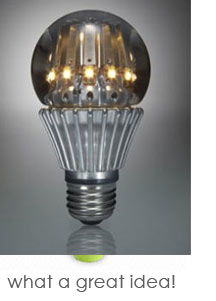
Saw this idea on slashdot a while back. Someone pointed out the obvious problem: somewhat hard to secure, given your signal could be spilling out of the window. Would encryption entirely solve that problem?
Encryption solves the problem of the signal spilling out the window. Besides, RF WiFi spills a lot more: it goes right through the walls.
But there are worse problems: who wants a “WiFi” that requires you to leave the lights on 24/7? Who wants a WiFi that requires you to run a wire from your router to every light socket in your house, or at least to a light socket in every room? It kind of defeats the whole idea of wireless, doesn’t it?
This idea is rather like windmills and PV: it could be useful in rare special circumstances, but it is far, far too limited and costly to make sense as a general purpose replacement for RF WiFi, just as windmills and PV are far, far too limited and costly to replace natural gas and coal for most electrical power generation.
Yeah but apparently it only works 1-way as yet…
seems that there are problems in talking back to the Bulb,
not that it would usually be a problem for us Lovers of Old Light Bulbs 😉
indeed – you’d prefer to waste money