

 By now, you’ve probably heard the news. The sun is going cold, and all that talk about global warming was just a fad, just like Glenn Beck always said. And by the way, scientists say we’re going into a new ice age. It’s a climate crock I’ve treated before.
Now, Fox News and others are spinning reports about recent model predictions of low solar activity.
What do the actual scientists who did the work say?
Something considerably less dramatic, according to Reuters:
“…..contrary to some media reports, this does not mean a new Ice Age is coming, Frank Hill of the National Solar Observatory said in a telephone interview.
“We have not predicted a Little Ice Age,” Hill said, speaking from an astronomical meeting in New Mexico. “We have predicted something going on with the Sun.”
Scientists are in no doubt that the sun has been acting oddly in recent years. Sunspot numbers ebb and flow in cycles lasting around 11 years but over the past three years, observable sunspots have been mostly missing.
These spots have been used by scientists to indicate the sun’s magnetic activity is diminishing, and that the sun may even be shrinking. Since 2007, visible sunspot activity has stalled, leading researchers to suggest that the next solar maximum (due in 2013) could be a long while coming. Instead, the sun could go into a prolonged lulllasting several decades.
Ordinarily, its activity varies over about 11 years, but since 2007 it seems to have stalled.
This week a string of researchers presented new data showing that the sun still isn’t perking up. That means, rather than having a solar maximum in 2013, we might not see one for a long time. Instead, the sun could go into a prolonged lull lasting several decades.
This has happened before, the most famous example being the Maunder Minimum of 1645-1715 when the sun became less luminous than normal and hardly any sunspots were seen on its surface. There is plenty of evidence that such “grand minima” cool the Earth: it’s one of the more dramatic effects the sun’s changing activity can have on our climate. The Maunder Minimum itself is widely linked to the Little Ice Age.
Here’s where the story lurches away from reality. According to the Global Warming Policy Foundation (of whom more here), the sun’s shutdown means that
The Earth – far from facing a global warming problem – is actually headed into a mini ice age.There’s a simple problem with this claim. Let’s assume that grand minima really do cool Earth’s climate: not every climate scientist is convinced of that, but for the sake of argument let’s go with it. Now the question becomes: how much do they cool it, and for how long?
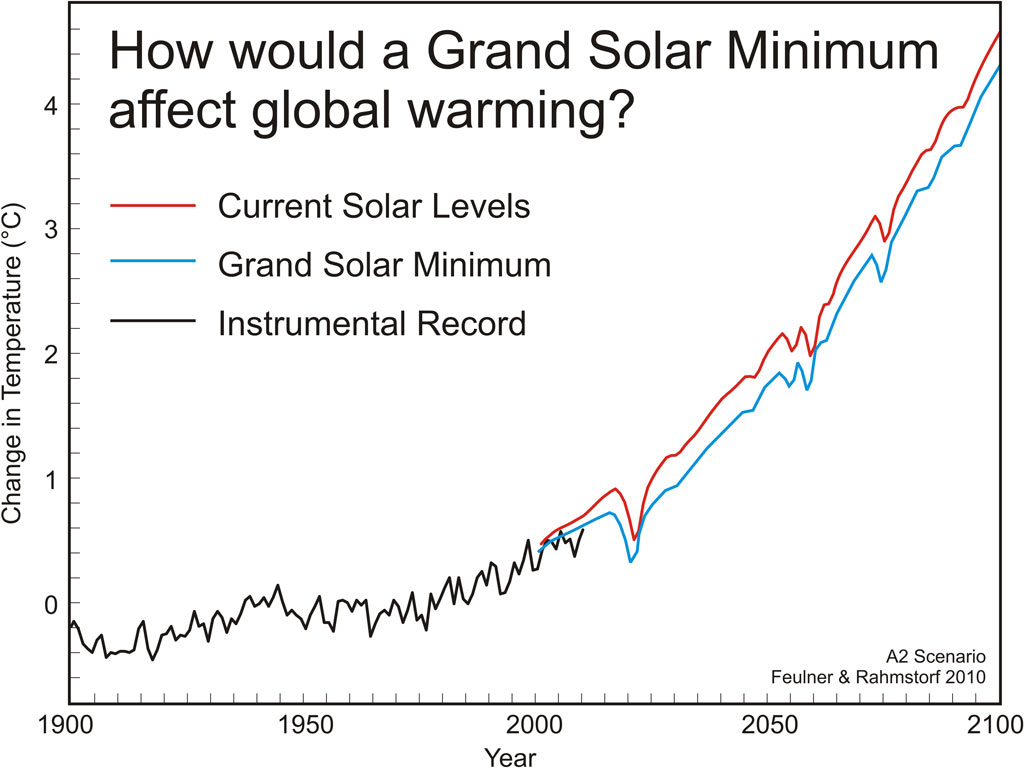
The straightforward answer is: not enough. Last year researchers modelled what would happen to global temperatures if a grand minimum started now and continued until 2100. They found that it would lower temperatures by 0.3 °C at most.
Scientists have been studying and remarking on the sun’s peculiar behavior for years, and as long ago as 2009, NASA scientists wrote:
Solar irradiance: The solar output remains low (Fig. 4), at the lowest level in the period since satellite measurements began in the late 1970s, and the time since the prior solar minimum is already 12 years, two years longer than the prior two cycles. This has led some people to speculate that we may be entering a “Maunder Minimum” situation, a period of reduced irradiance that could last for decades. Most solar physicists expect the irradiance to begin to pick up in the next several months — there are indications, from the polarity of the few recent sunspots, that the new cycle is beginning.

However, let’s assume that the solar irradiance does not recover. In that case, the negative forcing, relative to the mean solar irradiance is equivalent to seven years of CO2 increase at current growth rates. So do not look for a new “Little Ice Age” in any case.

NASA’s take was born out, as, even in the midst of the lowest solar minimum in a century, 2009, and 2010, were, respectively, the number 2, and number one warmest years in NASA’s instrumental record globally.
The possibility of imminent solar dormancy was raised by reports from the ongoing American Astronomical Society meeting of fading sunspots and dips in the sun’s magnetic patterns. Those are considered portents of solar inactivity, suggesting that the next solar minimum — a natural downturn in activity — would be especially pronounced, perhaps lasting for decades.
When that last happened, between the mid-17th and early 18th centuries, northern Europe experienced a period of unusually cold weather. Known as theMaunder Minimum, or more conversationally as the Little Ice Age, it’s a period historicized by accounts of ice skating on the Thames and seasonal inns built on Baltic Sea ice.
Press accounts of the new solar reports played up the Maunder Minimum angle, hinting that it might happen again. Some even implied that global warming might be counteracted.
In fact, the meaning of the latest sunspot reports is still being debated, as Andrew Revkin at Dot Earth has chronicled. But even if they really do portend a decades-long solar lull, studies already point to a minimal effect on climate.
Most Little Ice Age cooling appears to have been the result of coincidentally high volcanic activity that cloaked Earth in sunlight-blocking soot. As for the sun, a study published in 2001 in Science found that reduced solar activity produced a cooling effect of about 0.5 degrees Fahrenheit. In other estimates, the cooling is even more insignificant.
The Wired piece quotes Mike Mann of Penn State, comparing the sun’s fluctuations to greenhouse warming.
“The example I like to use is that greenhouse warming right now is the equivalent of 2 watts of power illuminating every square meter of the Earth’s surface. It’s like a Christmas tree light over every square meter. By mid-century, it will be closer to 4 watts,….the maximum impact factor of the sun is 0.2 watts per meter squared.”
A recent paper by Georg Fulner and Stefan Rahmstorf asked what might happen to earth’s climate in the event of a new solar minimum. That paper’s key graph is adapted above. The paper’s conclusion:
In summary, global mean temperatures in the year 2100 would most likely be diminished by about 0.1°C. Even taking into account all uncertainties in the temperature re- construction, the forcings, and the model physics, the overall uncertainty is estimated to be at most a factor of 3, so the offset should not be larger than 0.3°C. Comparing this to the 3.7°C and 4.5°C temperature rise relative to 1961–1990 until the end of the century under the IPCC A1B and A2 emission scenarios, respectively, a new Maunder‐type solar activity minimum cannot offset the global warming caused by human greenhouse gas emissions.
Heatwave edition – part 2 is a great segment. Very credible anecdotal stories in Austin suggest that Alex Jones (the person laughing all the way to the bank) is as rational as his on-air character is irrational.
You might want to read what the scientists really said, they do not predict an ice age but they also are far from saying this will not lead to a small one.
what is it about
“We have not predicted a Little Ice Age,”
that has you stumped?
Here is some of what they really said:
http://www.universetoday.com/86643/regular-solar-cycle-could-be-going-on-hiatus/
The scientists say:
“Hill said that some researchers say that the Sun’s activity can also play a role in climate change, but in his opinion, the evidence is not clear-cut. Altrock commented he doesn’t want to stick his neck out about how the Sun’s declining activity could affect Earth’s climate, and Penn added that Cycle 25 may provide a good opportunity to find out if the activity on the Sun contributes to climate change on Earth.”
“the sun can play a role in climate change”.
thank you, captain obvious.
I am not aware of any climate scientist that disagrees with that statement.
with 2 of the hottest years on record coming during this current solar minimum, the climate scientists point out that solar minimums and maximums are simply not what is driving the current warming.
Disagree, that is not most certainly not what they said, captain “true believer.”
http://en.wikipedia.org/wiki/The_True_Believer
Also, the regional changes may be much larger, particularly in the northern hemisphere, the bread basket of the world. This is not minor.
http://www.sciencemag.org/content/294/5549/2149.short
Also, this is not simply about total solar irradiance, the type of outputs from the sun are changing. This is a truly a first in modern times and somewhat unpredicatable for things like cloud formation:
http://www.agu.org/pubs/current/si/links/2010JA016301.pdf
Pulling climate scientists work out of context and using it to fog an issue is SOP for deniers, so you’re following the formula, I get that.
Ironically, you’re quoting a paper by Schmidt, (one of Hansen’s team, and advisor to this series) Mann (of hockey stick fame and ditto), and Rind, all of whom are well known for their concerns about climate change, and all of whom would agree that the current warming is not solar driven, and all of whom would agree that an extended minimum, though it may have regional effects, would barely slow the overall planetary warming due to GHG.
Regional changes due to arctic oscillation are, in fact, happening now — the last 2 severe winters in the northern hemisphere were correlated with a low arctic oscillation index. Your Science article abstract states lower solar irradiance may alter the arctic index and coincide with “colder temperatures over the Northern Hemisphere continents, especially in winter (1° to 2°C), in agreement with historical records and proxy data for surface temperatures.”
In other words, the real world, once again, is demonstrating how well Mann and Schmidt understand its processes.
The current change may be due to the solar minimum, or to decreased ice cover in the arctic, or both, or neither — and it could be long lasting. It coincides with the “global weirding’ that greenhouse driven change is bringing worldwide.
It’s always possible, in addition, that further regional effects due to poorly understood ocean current or other changes could happen at any time.
None of this alters the facts – that no one is expecting a “new ice age”, little or big, in response to an extended solar minimum, if it occurs, and that the atmospheric buildup of heat will continue until a new, higher equilibrium is established — how high, depends on how long we are willing to keep driving it.
I know exactly who I am citing and did so intentionally. You do not even believe the folks on your side, you pick more extreme positions. So you do now believe the cooling was more significant in the northern hemisphere than you stated?
You ignore completely the solar scientists I quote above, they sure seem to think we may see a more severe cooling and they come as close to saying as they can while maintaining scientific integrity, something Mann has lost completely with the recent sea level hockey stick paper, which was not even peer reviewed in any traditional sense.
Finally, look at the real data on sea level rise and atmospheric heating, it disagrees with the AGW hysteria and the GISS data which is Hansen controlled.
http://sealevel.colorado.edu/files/current/sl_ib_global.jpg
ftp://ftp.ssmi.com/msu/graphics/tts/plots/rss_ts_channel_tts_global_land_and_sea_v03_3.png
ftp://ftp.ssmi.com/msu/graphics/tls/plots/rss_ts_channel_tls_global_land_and_sea_v03_3.png
ftp://ftp.ssmi.com/msu/graphics/tlt/plots
/rss_ts_channel_tlt_global_land_and_sea_v03_3.png
Noone seems to find hockey sticks but Mann and Hansen and the IPCC (go read IPCC ’07 BTW, they had to disagree with the 2001 Science paper I cited in order to make the sun even more irrelevant to warming to make the CO2 effect larger).
The data does not follow, without data there is no science.
Well, let’s see, you have a Lower Stratosphere graph (TLS) that shows cooling, exactly as models predict. You have a combined stratosphere and troposphere graph (TTS) that shows nothing, which is kind of what one would expect.
and you avoid the lower tropospheric graphs, which show unequivocal warming.
http://en.wikipedia.org/wiki/Satellite_temperature_measurements
So you’re either ignorant, and don’t know that the models predict, and we observe, tropospheric warming and stratospheric cooling, or you are a deliberately misinforming troll.
either way, won’t work here.
curious readers who want to know what global temps and sea level are doing can go to NASA
http://climate.nasa.gov/keyIndicators/
check climate skeptic Roy Spencer’s global temps (he uses the same msu data you are misusing) here
http://www.drroyspencer.com/wp-content/uploads/UAH_LT_1979_thru_May_20111.gif
and check out what the US Navy’s Chief Oceanographer says about sea level rise, and arctic melt here
http://www.youtube.com/watch?v=CBBEyJVj5MY
and see video of the most well known climate skeptic scientists affirming the current warming here
Or you do not know what you are talking about, and the models are based on post-hoc analysis.
I have been around science along time, and have read thousands of papers. I do not believe the evidence for CO2 causing warming is nearly as strong as you do, and think that many of the papers you base your belief on are weak, at best. Time will tell who is correct.
Good luck in your quest, and go get a Ph.D. and take a stats course or ten.
Have a great week.
Can you site a single peer reviewed paper that contradicts basic science? The quantitative absorption and emission of atmospheric GHGs is well understood physics, calculated and measured. The (small) uncertainty is a function of overlapping atmospheric conditions, such as humidity, that are not homogeneous.
so you’ve backed off your “data”.
I see no evidence of statistical sophistication in your posts, but plenty evidence of knowingly distorting data. Fortunately, I’ve been “around science” enough to spot the BS you’ve tried to pass off here.
Anyway, thanks for playing.
Lets start with their papers, the most recent of which was not peer reviewed, but “edited”, something no journal but PNAS would even consider. It is on sea level rise and does not aqree with anyone, in fact see my link above and then read this:
http://www.pnas.org/content/early/2011/06/13/1015619108.full.pdf+html?sid=b6e8ef4f-0985-41a1-b50d-15d073667369
The supporting information is incomplete to validate the data:
http://www.pnas.org/content/early/2011/06/13/1015619108.full.pdf+html?sid=b6e8ef4f-0985-41a1-b50d-15d073667369
The paradigm paper on temp rise fails a basic stats evauation, even if you use their data (peer reviewed too). This paper is directly on GISS data:
http://projecteuclid.org/DPubS?service=UI&version=1.0&verb=Display&handle=euclid.aoas/1300715170
Here is the truth on CO2 and you must know that forcing only occurs to a particular point, after that more CO2 actually leads to a smaller rise rate in temp, not a smaller one:
http://www.sciencemag.org/content/330/6002/356.short
I can send more, but most go catcha flight and start work for the week.